
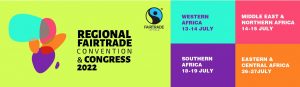
Fairtrade Africa, West Africa Network is organising its Regional Convention and Congress from the 13th to the 14th July 2022 in both Ghana and Cote d’Ivoire. This year’s event focuses on learnings and best practices from Fairtrade certified producer organisations on value addition and income diversification to remain resilient and viable farmer cooperatives.
The West Africa Regional Fairtrade Convention (RFC) is a biennial event organised by Fairtrade Africa West Africa Network which brings together all Fairtrade and non-Fairtrade producers and other stakeholders within and outside the region to deliberate on contemporary issues affecting producers and to propose ways of advancing the businesses of producers and their partners. Through the event, producers deliberate on new market opportunities, linkages with entrepreneurs in Agri processing as well as issues that relate to advocacy, youth and gender-related issues within agricultural supply chains.
The Regional Fairtrade Congress is organised to bring together producers for democratic decision making on governance of the regional network. It is a platform within FTA’s governance structure and decision-making process for representatives of each producer organisation in the region to meet and interact on issues affecting FTA’s work. Mainly, the congress enables producers to receive updates on happenings within FTA and the FT system and to raise issues of concern to them for discussion at FTA General Assembly (GA) and other levels within the FT system. Additionally, delegates at the Congress also elect their regional representatives to the FTA GA.
In his address, Benjamin Kouame, Fairtrade Africa Board Chair focused on trade Africa’s strategic vision on product and market development for Fairtrade certified producers. He emphasised the need for engaging stakeholders on policy, financing and market linkages that support and promote trade.
.jpeg)
In his opening remarks, Isaac Tongola, Executive Director of Fairtrade Africa emphasised the role of Fairtrade Africa in empowering its producers to become more resilient and transformed organisations, in order to ensure sustainable livelihoods. The opportunities that market linkages from the AfCFTA element present are critical to helping producers step- up on their efforts at adding value to their commodities in order to promote intra-African trade.
Fairtrade is committed to helping producers address the challenges that climate change poses to agriculture and farmer livelihoods. Despite the changing climate conditions, we continue to support our producers to be resilient in adaptation and mitigation approaches by focusing on new areas and project interventions that enable value addition and income diversification”, he added.
Edward Akapire, Head of Region for Fairtrade Africa West Africa Region reiterated the commitment of Fairtrade to strengthen its member producer organisations: “The West Africa Fairtrade Network has over the period mobilised its members to access the capacity building on various topics relevant to our operations as Farmers and Workers, supported in the area of fundraising and engaged policymakers in an attempt to achieve favourable terms for producers”.
In Cote d’Ivoire, Fairtrade introduced the Farmer Business School under the Recover Africa Project. The Farmer Agribusiness Resilience School (FARS), pursues the ambitions of phase 1 by improving the resilience of producers due to the Covid-19 pandemic. This phase aims at the one hand to maintain and diversify relationships within supply chains. On the other hand, it aims to guarantee the continuity of food security and income generation activities around the school farms.
The purpose is to strengthen local food security through the availability of quality agro-pastoral products on local markets; improve the economic resilience of producers by creating and maintaining income-generating activities. Through the project, it is expected that school farms are functional and generate agro-pastoral products on local markets. It is also expected that producers through the training received from school farms will carry out income-generating activities.
The Women's School of Leadership (WSOL) is a training, mentoring and coaching programme aimed at improving participants' basic leadership skills and application of human rights provisions on gender issues in their own environment. Through the training, women are empowered to decide on their future through increased capacity to make decisions and take action on themselves; take control and manage resources by being supported to actively participate and voluntarily assume leadership roles in their Producer Organisations and communities.
In Ghana, organisations like Bia West Cooperative, is partnering with Fairtrade on a Mondelez Cocoa Life project, focused on crop diversification. Producers have ventured into other crops apart from cocoa. These include rice farming, and maize farming among others. Other Producer Organisations like Bomarts Ltd have invested in fruit processing for exports.
Since it joined Fairtrade certification, Bomarts exporting processed and fresh mango and pineapple to customers mostly in Europe and the Middle East market, the company produces and sells approximately 500 tons of tropical dried fruits per year. At the processing unit, a total of 5 metric tonnes of dried fruit per day are processed from mango, pineapple, coconut, papaya and banana. Kuapa Kooko is the oldest Fairtrade certified cocoa producer organisation in Ghana.
Under the alternative livelihoods component of the KKFU sustainability programme, about 220 women have received skills training. Now we have in Kuapa Kokoo shower gel, dish washing soap, washing powder, Hair food, Parazone, local rice, among others. There has also been skills training for women in batik tie and dye.
In its efforts to ensure sustainability in production, Fairtrade Africa has been implementing projects aimed at ensuring adaptation and mitigation efforts to address the challenges of climate change, price volatility, the effects of the pandemic and an increasing global inflation in the supply chain, in with line with the new 2021-2025 global strategy that puts the producer at the heart of all transformation and that focuses on digitalisation, impact data, transparency and traceability that is needed to drive agricultural growth.
Comments