
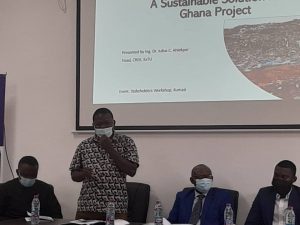
The Centre for Renewable Energy and Energy Efficiency (CREK) at the Kumasi Technical University in partnership with other local partners of the hybrid Waste-to-Energy pilot project has held a consultative meeting in Kumasi in the Ashanti region on November 16, 2021 to solicit views from stakeholders in renewable energy sector on the establishment of the project in the region.
The 5.8 million Euro Waste-to-Energy (W2E) conversion plant project, which is currently under constructions, is situated at Gyankobaa, a major ginger producing area in the Atwima Nwabiagya South Municipality in Ashanti Region. The pilot plant will use a hybrid solar PV, biogas and a pyrolysis plant to generate electricity from domestic waste.
Speaking with Ign. Dr. Julius Ahiekpor, Head of CREK, he stressed that all the stakeholders are willing to collaborate with each other to ensure the success of the project and the potential of building 10 more plants across the country by 2040 on a large scale to generate between 1-5MW.
He therefore encouraged others to join the partnership to solve both the power generation and sanitation problems of the country.
This project aims to improve sanitation in the project communities by up to 50% while providing compost for organic farming across the country”, he added.
Read also: Ghana sleeping on renewable energy adoption
Apart from creating more than 50 jobs for Ghanaians, Dr. Ahiekpor also said that the project will also include the training of post-doctorates, doctorates, masters’ students and academics professionals on hybrid bio-gas pyrolysis systems.
He underlined that the 12,000 tonnes of waste generated annually by the Atwima Nwabiagya municipality would be put to good use and provide employment for the citizens. Meanwhile, the pilot plant needs just about 3,000 tonnes of waste per annum to run.
Dr. Ahiekpor, was hopeful that the successful completion of the four-year project will help to scale up to other communities across the country.
The project’s success will not only help Ghana to address her energy and sanitation challenges but also encourage replication of the project nationwide,” he stated.
The project is seen as one of the remedies to Ghana’s waste management and power generation challenges, while generally reducing the health hazards from pollution and climate change.
The Dean of the faculty of engineering and technology, Prof. Robert Nagre, in his welcome address reiterated the need for Ghana to properly diversify its energy sources to enable the country address its energy challenges efficiently.
The country needs to diversify its energy sources because that’s the only way to ensure energy security and prevent the daily disruption facing this country on daily basis,” he noted.
He added that energy is essential to development and in the past, hydro alone has presented to challenges which necessitated the need to explore other options.

He said Ghana’s solid waste situation is a blessing in disguise, adding that “the country’s waste is carbonaceous and combustible and anything that can be combustible can be converted to energy. What we see to be waste is actually a resource”
The purpose of the workshop was to afford the participants to be abreast with the progress of implementation of the waste to energy project and also bring to fore the new development in the waste to energy sector.
It also provided the participants the opportunity to share experiences, lessons learnt in existing projects and how to effectively partner the private sector to convert waste to energy in the country, while exploring innovative ways of sourcing funds to build and expand the project across the country.
The 400-kilowatt facility, known worldwide as the ‘Hybrid-PV- Biogas-Pyrolysis-Plant’, has the capacity to convert 12 tonnes of waste into bio fertilizer and energy daily and is being funded by the German government. And it is led by the University of Rostock-Germany and SRH-Belin with its Ghanaian partners such as the Council for Scientific and Industrial Research (CSIR), Ministry of Science and Technology on Innovation, Kumasi Technical University (KsTU), Centre for Energy, Environment and Sustainable Development (CEESD GH), West African Science Service Centre on Climate Change (WASCAL) among others.
The workshop brought together key actors from academia, private sector, financial institutions, development partners, Ministry of Energy, Energy Commission, Public Utilities Regulatory Commission, local assemblies, NGOs, among others.
Comments