The Asian African Consortium (AAC), a subsidiary of Jospong Group of Companies and the University of Cape Coast (UCC) have entered into a Memorandum of Understanding to undertake research to boost rice, maize and soya production in the country.
The objectives of this partnership are to identify common areas of collaboration, address the overall mandate of the parties, develop a plan for collaborative operations and detail the scope and principles of engagement between the parties, while aiming at achieving food efficiency in the country.

The CEO of the AAC, Adelaide Araba Siaw Agyepong, at the signing ceremony in Accra on Thursday April 20, 2023, noted that the agreement will facilitates ACC’s collaborations with the various UCC research institutes across Ghana to depeen research and development to social change challenges for economic growth and development.
She further added that it will also facilitate the establishment of a research and development consortium comprising of business, crop science, technology, agriculture engineering, chemical engineering as a standing committee to advise on the full value chain in rice, maize and soya and other stable production.
Again, this arrangement will facilitate the establishment of a seedling centre for the commercial production of seedlings for sale to farmers,” she hinted.
She emphasized that “the ACC’s integrated rice project is to make Ghana self-sufficient in rice production resulting in significant economic benefit for the country”.
The AAC CEO noted that the partnership is crucial for increasing collaboration and boosting Ghana’s economy.
Siaw Ageypong, who was particularly pleased with the arrangement between the two institutions, was hopeful that this MoU will pave way for many other collaborations between the two institutions.
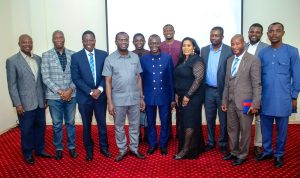 Prof. Johnson Nyarko Bampong - Vice Chancellor of the University of Cape Coast, reiterated that the University is specialized at training students to be entrepreneurs and self-sufficient who can create jobs for others.
We also focus on empowering our students with competences to succeed in life” he added.
He lamented that with Ghana’s abundant resources and arable land, it still imports food, which it
can produce locally.
It is very said when Ghanaians we have to import from other countries to feed ourselves yet countries with no arable lands have found ways to produce food locally and even export” he cried.
He therefore stressed that the University is fully behind the project.
He noted that the University in its small way of complementing efforts to curb importation has acquired a 450 acre of land for agricultural purposes.
Executive Chairman of Jospong Group, Dr. Joseph Siaw Agyepong, in a brief remarked noted that agriculture and research must go hand in hand to ensure that the country derives its full benefits.
He noted that rice is now a stable food in Ghana and initiatives must be taken to produce quality and the needed quantity backed by research and this cannot be achieved without the academia.
He encouraged the University to ensure that they come up with seedlings that can withstand the Ghanaian conditions as well as produce the needed yields for maximum benefits.
We have the knowledge, resources to see this through, therefore you have no excuse not to perform” he reminded the academia.
Background
Last year, Asian African Consortium entered partnership with major rice industry players in Thailand to develop an integrated rice farming project. This move by Jospong Group stemmed from the government’s decision to boost the economy through import substitution.
A core team later visited Thailand for the Ghana-Thailand Business conference in March 2023 with researchers from various universities in Ghana as well as major players in the rice industry.
Last year, Ghana spent over GH¢6.8billion (equivalent to US$560million at current market rates) importing rice, a grain that can be produced locally.
While total rice consumption stood at 1.4 million metric tonnes in 2022, imports valued at US$560 million accounted for 800,000 metric tonnes (mt) of the consumption figure, with domestic production catering for the remaining demand – according to data from IDH Sustainable Trade, a foundation headquartered in The Netherlands.
Similarly, according to the Ministry of Food and Agriculture, between 2010 and 2020 the country’s rice imports hit a staggering US$8billion. This, in addition to imports of other food items that can be produced locally, has been a major source of concern for stakeholders.
Comments