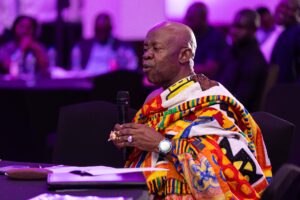
Traditional authorities have expressed growing frustration over what they describe as their exclusion from key mining decisions and the inequitable distribution of mineral royalties, calling on government to reform the country's mining governance framework.
The President of the National House of Chiefs, Ogyeahohoo Yaw Gyebi II, said successive governments have consistently failed to consult chiefs before granting mining leases on customary lands, despite traditional authorities being the custodians of those lands.
Speaking to journalists on the sidelines of a mining forum in Accra, he argued that excluding chiefs from the licensing process undermines community participation and weakens accountability in mining host communities.
"When I say government, I am referring to successive governments in this country. When they are granting mining leases, they don't inform Nananom, they don't get us involved, even though Nananom owns the land in this country," he said.
He maintained that traditional authorities should be formally involved in all mining concessions involving customary lands, stressing that chiefs provide an enduring governance structure capable of keeping communities informed.
"Our concern is that any mining lease being granted, especially on land, Nananom should be involved. Nananom don't have tenure; we are always around. Every village has a chief, from the village chief to the divisional chief and the paramount chief. Once we deal with Nananom, almost everybody gets to know about it," he stated.
Calls for greater transparency
Ogyeahohoo Yaw Gyebi II also questioned the transparency surrounding the payment of mineral royalties to traditional authorities.
According to him, although regulations require the Office of the Administrator of Stool Lands to distribute royalties to beneficiaries, chiefs are often informed that no funds have been received.
"The regulation says the Office of the Administrator of Stool Lands should take our portion and share it. But when we contacted them, they said they had not received anything. There is no prescribed procedure to indicate that when royalties are paid to the Ghana Revenue Authority, within two or three months all the other beneficiaries should have received theirs," he said.
Demand for larger royalty share
The National House of Chiefs President described the current royalty allocation to traditional authorities as grossly inadequate, arguing that it falls far short of the resources required for chiefs to support development within their communities.
He noted that traditional leaders are expected to maintain palaces, preserve chieftaincy institutions, provide scholarships, support vulnerable people and undertake various community development initiatives.
Using a hypothetical example, he said that even where a mining company generates substantial royalty payments, only a small fraction eventually reaches the traditional area.
"That figure is woefully inadequate. We are demanding 30 per cent of the royalties instead of the 8 per cent that they are paying now," he said.
He further claimed that traditional authorities were never consulted before the existing royalty-sharing arrangement was adopted.
"Even the 8 per cent, they never consulted us. I'm hearing this for the first time," he added.
Ogyeahohoo Yaw Gyebi II called on government to review the mineral royalty distribution framework to ensure mining communities receive a fairer share of the wealth generated from their lands while strengthening collaboration between government, mining companies and traditional authorities.
His remarks come amid renewed discussions on mineral value retention and the need to ensure that communities hosting mining operations derive greater socio-economic benefits from Ghana's natural resource wealth.
Comments