
By Samuel Dowuona
As legal proceedings involving Zeepay Ghana Limited continue, documents filed in court and information emerging from related proceedings have raised questions about some of the allegations surrounding the company, its founder and Chief Executive Officer, Andrew Takyi-Appiah.
The matters remain before the courts and other regulatory bodies, and several of the issues in dispute have yet to be conclusively determined.
Ahead of the final determination of the issues before the courts and other regulatory bodies, the financial industry regulator, Bank of Ghana has suspended Zeepay’s DEMI (dedicated electronic money issuer) license citing “multiple regulatory breaches.” But there are still several unanswered questions.
The Mobile Money Wallet at the Centre of Allegations
One of the allegations that has received significant public attention is the claim that customer funds were processed through what has been described as the CEO’s personal MTN Mobile Money wallet.
However, court documents reviewed by Techfocus24 indicate that the wallet in question is actually a merchant wallet registered in the name of Zeepay’s business operations (ZeepayCIN), with Andrew Takyi-Appiah listed as the authorised handler for registration purposes.
By law, all wallets, including merchant wallets must be linked to the Ghana Card of an authorised representative or account administrator, even where the wallet is operated on behalf of a corporate entity by persons other than the registered handler.
Examples of this are seen in exhibits presented in court, showing that mobile wallets registered in the names of some banks, for instance, also had the names of individual staff members as handlers because their Ghana Cards were used in the registration process. The same thing happens with wallets belonging to school alumnae groups, various associations, church groups, etc, even though in most of the cases, the day to day operation of the wallet is done by persons other than the authorized handler.
So, whereas on paper, the authorized handler can be held responsible for all transactions on the wallet, it does not necessarily mean he or she actually did every transaction on that wallet. This is critical.
In the specific case of Zeepay, documents before the court show that the wallet in question was registered under the name “ZeepayCIN”, with Andrew Takyi-Appiah’s identity appearing because his Ghana Card was used during the registration process. The documents also indicate that operational access to the wallet was not limited to the CEO but extended to other authorised personnel within the company.
Request to Amend Wallet Name
Techfocus24 also found that, per the court documents, Zeepay wrote to MTN Ghana way back in November 2023 requesting that the merchant wallet’s registered name be changed from “Andrew Takyi-Appiah (ZeepayCIN)” to “Zeepay Ghana Limited.”
Find a copy of that letter below
The correspondence forms part of the material filed in the ongoing proceedings. The fact that the CEO’s name is still attached to the original name of the wallet suggests the name change was not done.
MTN Ghana has not publicly commented on the specific wallet registration referenced in the court documents. They are also yet to answer questions on whether they effected the name change as requested by Zeepay about three years ago.
Questions Over Merchant Wallet Classification
The dispute has also drawn attention to the distinction between merchant wallets and individual mobile money wallets.
Some industry observers argue that whereas merchant wallets remain corporate accounts in practice, they are routinely administered by designated individuals. Others note that regulatory treatment, operational controls and transaction limits may differ depending on the wallet category and the applicable Bank of Ghana framework.
Indeed the kinds of amounts being alleged to have been transacted on the supposed personal wallet of the Zeepay CEO raises critical questions about the regulations on transaction limits on the various categories of personal and even merchant wallets, and how the wallet operator allowed that to happen if indeed it happened.
These issues could become relevant as the legal proceedings continue and evidence is examined.
Silence That Raises More Questions Than Answers
One of the most striking aspects of the controversy surrounding Zeepay Ghana and its Chief Executive Officer, Andrew Takyi-Appiah, is not simply the allegations themselves, but the absence of definitive clarification from the institution that is arguably best placed to provide it—MobileMoney Fintech Limited (MMFL).
The allegation that millions of dollars in customer funds were channelled through the CEO’s “personal” MTN Mobile Money wallet has been widely repeated in public discourse. Yet, despite the seriousness of that allegation and the damage it has caused to both the individual and the company, there has been no public statement from MMFL directly confirming whether the wallet in question was in fact a personal wallet or a corporate merchant wallet registered under an authorised representative.
This silence is noteworthy because MTN possesses the records capable of conclusively resolving that narrow but critical factual issue. If the wallet was a merchant wallet, MTN would know. If it was a personal consumer wallet, MTN would equally know.
A Question Only MTN Can Answer
The issue is straightforward:
* Was the wallet a personal MTN Mobile Money wallet belonging to Andrew Takyi-Appiah?
* Or was it a merchant wallet belonging to Zeepay, with the CEO’s Ghana Card used as part of the registration process in accordance with operational requirements?
That distinction is fundamental. Without a clear answer from the wallet operator, speculation continues to fill the vacuum.
In our search for answers to that specific question, Techfocus24 reached out to the CEO of MMFL Shaibu Haruna, and response was that “as a regulated financial institution MMFL cannot share the wallet details of our customers with anyone except as prescribed by law.”
So, the question still remains unanswered, and the unsubstantiated allegation that the Zeepay CEO used his personal MTN wallet to transact millions of dollars on behalf of the company continues to dominate the narrative.
The Missing Evidence
Perhaps the most significant unanswered question is this:
Despite months of allegations that the CEO received company funds into his personal mobile money account, no publicly available evidence has identified a specific personal MTN Mobile Money wallet belonging to him.
No wallet number has been publicly produced.
No registration record identifying an individual consumer wallet in his name has been published.
No documentary evidence has emerged demonstrating the existence of such a personal wallet.
If such a wallet exists and formed the basis of the allegations, it would be reasonable to expect that its existence could be established through documentary records.
Conversely, if the only wallet involved is the Zeepay merchant wallet, then describing it as the CEO’s personal wallet creates a materially misleading impression of how merchant wallet registration operates.
Has MMFL always been silent on such issues?
MobileMoney Fintech Limited has previously shown that it is prepared to issue public statements when allegations concerning the integrity of its systems. For example, the company has publicly responded to allegations of unauthorised withdrawals and alleged security breaches by explaining the outcome of its investigations and correcting public misconceptions where appropriate.
Against that background, the absence of any comparable clarification on whether the wallet at the centre of this case was a personal or merchant wallet naturally invites questions.
Those questions include:
* Has MMFL concluded internally what type of wallet was involved?
* If so, why has it not publicly clarified that factual issue?
* Has any regulator requested MMFL not to comment while proceedings continue?
* Or has MMFL chosen to remain silent simply because the matter forms part of ongoing legal proceedings?
At present, there is no publicly available evidence answering these questions.
The Broader Public Interest
The issue extends beyond Zeepay or its CEO.
Millions of Ghanaians rely on mobile money every day. Public confidence in the system depends on accurate information about how merchant wallets are established, how they are registered, and how they are administered.
If merchant wallets routinely display the name of an authorised representative because of Ghana Card registration requirements, then greater public education is needed to avoid confusion between a corporate merchant wallet and a privately owned consumer wallet.
Conclusion
The central factual issue has become remarkably simple.
If Andrew Takyi-Appiah maintained a personal MTN Mobile Money wallet through which company funds were allegedly processed, the wallet operator, MMFL should be capable of producing evidence of that.
If, on the other hand, the transactions occurred through a corporate merchant wallet administered on behalf of Zeepay, that distinction deserves to be clearly explained.
Until that question is definitively answered by documentary evidence or through the courts, the public is left with competing narratives rather than established facts.
In a matter that has attracted national attention and significant regulatory consequences, greater transparency from all parties—particularly those holding the underlying records—would contribute to a more informed public debate rather than one driven by inference or assumptions.
Meanwhile, there is a whole fraud angle to this matter for which a December 17, 2025 petition to the police CID, and a March 2026 KPMG Forensic Audit Report on the Treasury and Foreign Exchange Activities of Zeepay provide some intriguing details. Techfocus24 will look at that in subsequent analysis.
The Mobile Money Wallet at the Centre of Allegations
One of the allegations that has received significant public attention is the claim that customer funds were processed through what has been described as the CEO’s personal MTN Mobile Money wallet.
However, court documents reviewed by Techfocus24 indicate that the wallet in question is actually a merchant wallet registered in the name of Zeepay’s business operations (ZeepayCIN), with Andrew Takyi-Appiah listed as the authorised handler for registration purposes.
By law, all wallets, including merchant wallets must be linked to the Ghana Card of an authorised representative or account administrator, even where the wallet is operated on behalf of a corporate entity by persons other than the registered handler.
Examples of this are seen in exhibits presented in court, showing that mobile wallets registered in the names of some banks, for instance, also had the names of individual staff members as handlers because their Ghana Cards were used in the registration process. The same thing happens with wallets belonging to school alumnae groups, various associations, church groups, etc, even though in most of the cases, the day to day operation of the wallet is done by persons other than the authorized handler.
So, whereas on paper, the authorized handler can be held responsible for all transactions on the wallet, it does not necessarily mean he or she actually did every transaction on that wallet. This is critical.
In the specific case of Zeepay, documents before the court show that the wallet in question was registered under the name “ZeepayCIN”, with Andrew Takyi-Appiah’s identity appearing because his Ghana Card was used during the registration process. The documents also indicate that operational access to the wallet was not limited to the CEO but extended to other authorised personnel within the company.
Request to Amend Wallet Name
Techfocus24 also found that, per the court documents, Zeepay wrote to MTN Ghana way back in November 2023 requesting that the merchant wallet’s registered name be changed from “Andrew Takyi-Appiah (ZeepayCIN)” to “Zeepay Ghana Limited.”
Find a copy of that letter below
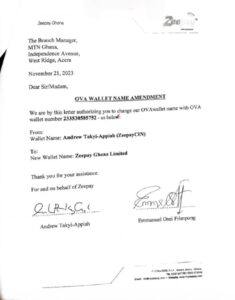
The correspondence forms part of the material filed in the ongoing proceedings. The fact that the CEO’s name is still attached to the original name of the wallet suggests the name change was not done.
MTN Ghana has not publicly commented on the specific wallet registration referenced in the court documents. They are also yet to answer questions on whether they effected the name change as requested by Zeepay about three years ago.
Questions Over Merchant Wallet Classification
The dispute has also drawn attention to the distinction between merchant wallets and individual mobile money wallets.
Some industry observers argue that whereas merchant wallets remain corporate accounts in practice, they are routinely administered by designated individuals. Others note that regulatory treatment, operational controls and transaction limits may differ depending on the wallet category and the applicable Bank of Ghana framework.
Indeed the kinds of amounts being alleged to have been transacted on the supposed personal wallet of the Zeepay CEO raises critical questions about the regulations on transaction limits on the various categories of personal and even merchant wallets, and how the wallet operator allowed that to happen if indeed it happened.
These issues could become relevant as the legal proceedings continue and evidence is examined.
Silence That Raises More Questions Than Answers
One of the most striking aspects of the controversy surrounding Zeepay Ghana and its Chief Executive Officer, Andrew Takyi-Appiah, is not simply the allegations themselves, but the absence of definitive clarification from the institution that is arguably best placed to provide it—MobileMoney Fintech Limited (MMFL).
The allegation that millions of dollars in customer funds were channelled through the CEO’s “personal” MTN Mobile Money wallet has been widely repeated in public discourse. Yet, despite the seriousness of that allegation and the damage it has caused to both the individual and the company, there has been no public statement from MMFL directly confirming whether the wallet in question was in fact a personal wallet or a corporate merchant wallet registered under an authorised representative.
This silence is noteworthy because MTN possesses the records capable of conclusively resolving that narrow but critical factual issue. If the wallet was a merchant wallet, MTN would know. If it was a personal consumer wallet, MTN would equally know.
A Question Only MTN Can Answer
The issue is straightforward:
* Was the wallet a personal MTN Mobile Money wallet belonging to Andrew Takyi-Appiah?
* Or was it a merchant wallet belonging to Zeepay, with the CEO’s Ghana Card used as part of the registration process in accordance with operational requirements?
That distinction is fundamental. Without a clear answer from the wallet operator, speculation continues to fill the vacuum.
In our search for answers to that specific question, Techfocus24 reached out to the CEO of MMFL Shaibu Haruna, and response was that “as a regulated financial institution MMFL cannot share the wallet details of our customers with anyone except as prescribed by law.”
So, the question still remains unanswered, and the unsubstantiated allegation that the Zeepay CEO used his personal MTN wallet to transact millions of dollars on behalf of the company continues to dominate the narrative.
The Missing Evidence
Perhaps the most significant unanswered question is this:
Despite months of allegations that the CEO received company funds into his personal mobile money account, no publicly available evidence has identified a specific personal MTN Mobile Money wallet belonging to him.
No wallet number has been publicly produced.
No registration record identifying an individual consumer wallet in his name has been published.
No documentary evidence has emerged demonstrating the existence of such a personal wallet.
If such a wallet exists and formed the basis of the allegations, it would be reasonable to expect that its existence could be established through documentary records.
Conversely, if the only wallet involved is the Zeepay merchant wallet, then describing it as the CEO’s personal wallet creates a materially misleading impression of how merchant wallet registration operates.
Has MMFL always been silent on such issues?
MobileMoney Fintech Limited has previously shown that it is prepared to issue public statements when allegations concerning the integrity of its systems. For example, the company has publicly responded to allegations of unauthorised withdrawals and alleged security breaches by explaining the outcome of its investigations and correcting public misconceptions where appropriate.
Against that background, the absence of any comparable clarification on whether the wallet at the centre of this case was a personal or merchant wallet naturally invites questions.
Those questions include:
* Has MMFL concluded internally what type of wallet was involved?
* If so, why has it not publicly clarified that factual issue?
* Has any regulator requested MMFL not to comment while proceedings continue?
* Or has MMFL chosen to remain silent simply because the matter forms part of ongoing legal proceedings?
At present, there is no publicly available evidence answering these questions.
The Broader Public Interest
The issue extends beyond Zeepay or its CEO.
Millions of Ghanaians rely on mobile money every day. Public confidence in the system depends on accurate information about how merchant wallets are established, how they are registered, and how they are administered.
If merchant wallets routinely display the name of an authorised representative because of Ghana Card registration requirements, then greater public education is needed to avoid confusion between a corporate merchant wallet and a privately owned consumer wallet.
Conclusion
The central factual issue has become remarkably simple.
If Andrew Takyi-Appiah maintained a personal MTN Mobile Money wallet through which company funds were allegedly processed, the wallet operator, MMFL should be capable of producing evidence of that.
If, on the other hand, the transactions occurred through a corporate merchant wallet administered on behalf of Zeepay, that distinction deserves to be clearly explained.
Until that question is definitively answered by documentary evidence or through the courts, the public is left with competing narratives rather than established facts.
In a matter that has attracted national attention and significant regulatory consequences, greater transparency from all parties—particularly those holding the underlying records—would contribute to a more informed public debate rather than one driven by inference or assumptions.
Meanwhile, there is a whole fraud angle to this matter for which a December 17, 2025 petition to the police CID, and a March 2026 KPMG Forensic Audit Report on the Treasury and Foreign Exchange Activities of Zeepay provide some intriguing details. Techfocus24 will look at that in subsequent analysis.
Comments