 By Francis Atayure Abirigo
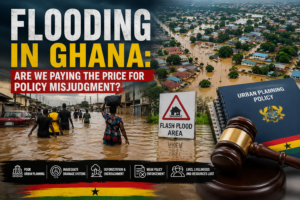
The recent flooding in major cities across Ghana, particularly in Accra, has once again exposed the deep cracks in our sanitation and waste management systems. Lives have been disrupted, homes submerged, businesses destroyed, and livelihoods threatened. Gutters are choked with plastic and solid waste. Rivers and drains can no longer contain the pressure of heavy rains. The result is devastation.
As Ghanaians search for answers, one uncomfortable question must be asked: Did the cancellation of the YEA-Zoomlion sanitation contract contribute significantly to the sanitation crisis we are witnessing today? Answer is yes.
But this question is not about assigning simplistic blame. It is about honestly assessing whether decisions made in the name of reform have produced better outcomes or worsened existing problems.
For over a decade, my brother one of Ghana’s investigative journalists Manasseh Azure Awuni consistently criticized Zoomlion Ghana Limited and its contracts with government, especially those relating to sanitation and waste management. His investigations raised concerns about transparency, value for money, and operational efficiency. He has been widely quoted to have said government should cancel the contracts with Zoomlion describing them as dubiuos, shady etc. At last the contract was refused renewal in 2025.
In every democracy, such scrutiny is important. Accountability matters.
However, accountability must also be balanced with national interest and practical realities.
The danger arises when public pressure generated through sustained criticism and one’s disinterest leads to decisions driven more by sentiment than by strategic planning. That is where I believe Ghana may have made a costly mistake.
The cancellation of the YEA-Zoomlion contract was welcomed by some people who believed Metropolitan, Municipal and District Assemblies (MMDAs) could independently manage waste collection and sanitation services more effectively. That assumption now deserves serious re-examination.
The evidence on the ground is troubling. Indeed it smacks of a total system collapse.
Sanitation conditions in many parts of Ghana have deteriorated. Waste accumulation is becoming more visible. Drainage systems are increasingly clogged. Flooding incidents appear more frequent and more severe, even at the start of the rainy season.
This is not merely a weather problem. It is also a waste management problem caused by our biases against Ghanaian companies.
For years, Zoomlion played a central role in coordinating sanitation activities nationwide successfully. One may debate contract structures, payment models, or implementation gaps, but few can deny that the company built an extensive operational system that supported waste collection, drain desilting, and environmental sanitation in communities across Ghana.
The reality is that waste management at national scale requires logistics, coordination, infrastructure, manpower, and discipline. It is not enough to assume local assemblies can simply absorb such responsibilities overnight.
I have consistently argued that MMDAs face structural challenges, including political interference, inadequate funding, procurement bottlenecks, and competing local interests. These realities weaken their ability to deliver consistent sanitation services at scale.
Sadly, current developments seem to confirm these concerns.
Today, many assemblies are visibly struggling to manage waste just in one and a half years. The consequences are being felt by ordinary citizens through poor sanitation and worsening floods.
This is why I believe government must honestly reassess the decision.
As someone who supported President John Dramani Mahama’s return to power and worked hard in that political journey, I must admit my disappointment with this policy direction. Leadership requires listening to citizens, yes, but leadership also requires resisting pressure when long-term consequences have not been fully considered.
Not every popular demand leads to good policy outcomes.
Sometimes the loudest voices shape public opinion, but practical governance requires careful judgment, consultation, and evidence-based decisions.
I have never argued that Ghanaian companies are beyond criticism simply because they are local. No institution is perfect. Every company, whether local or foreign, must be held accountable.
My approach has always been straightforward: where there are concerns, stakeholders should engage, identify weaknesses, and implement reforms. That is how nations grow. We build by correcting and improving, not by dismantling without a stronger replacement.
The goal should never be destruction. The goal should be improvement.
In the case of Zoomlion, perhaps reforms were necessary. Perhaps stronger accountability mechanisms were needed. But was outright cancellation the best solution? And that was what my brother Manasseh advocated and got at last.
Looking at current realities, many Ghanaians are beginning to ask whether we threw away a functioning system without adequately preparing a better alternative.
The flooding crisis should serve as a wake-up call.
Government must urgently review Ghana’s sanitation architecture and assess whether current structures are fit for purpose. This should not be a matter of politics, media narratives, or personal victories. It should be about protecting lives, safeguarding property, and preserving public health.
Encouragingly, despite the contract cancellation and criticism, Zoomlion Ghana Limited and the Jospong Group have once again demonstrated commitment to national service through emergency interventions following the recent floods.
Their corporate social responsibility efforts, including desilting gutters, disinfecting, evacuating waste, and supporting sanitation interventions in affected areas, are commendable. These actions are critical in reducing the risk of cholera and other communicable diseases that often follow flooding.
This is the kind of national collaboration Ghana needs.
The sanitation crisis before us demands pragmatism, not pride and point scoring. It demands solutions, not ideological battles.
Government should therefore reconsider its position on the cancelled contract or, at the very least, engage all relevant stakeholders to develop a stronger, more effective national sanitation framework.
Ghana cannot afford to lose the fight against filth.
Today , Zoomlion has following its 20years track record of effective and transformative waste management in Ghana spread its tentacles across Africa and its operating in over 29 African countries. Yes that is it Zoomlion has a 30years waste management contract with Nigeria-Abuja, Kenya and many others. They came to love Zoomlion’s operations in Ghana and embraced it in their own countries.
The floods have spoken loudly in Zoomlion’s mother homeland Ghana following an unpopular decision we all took thinking about destruction without improvement.
If we want let’s listen together, if not let’s wallow in our filth forever together.
I come in peace:

The writer is a Development Communications expert, a student of law, politics and a PhD Candidate in Social Change Communication at the Faculty of Communication , Innovation and Media Studies, UDS-Nyankpala
Comments