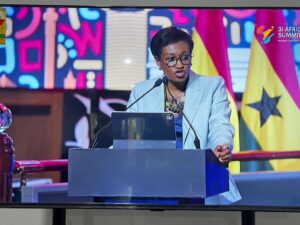
Nathalie Kouassi-Akon, Divisional Director for West Africa (Gulf of Guinea) at the International Finance Corporation (IFC), has called for stronger digital integration across Africa, warning that fragmented systems could slow the continent’s economic transformation despite rapid growth in internet access.
Speaking on day two of a three-day 3i Africa Summit in Accra, she said Africa must move beyond simply expanding digital access and focus on building interconnected systems that drive productivity, regional trade and job creation.
According to her, internet use in Sub-Saharan Africa grew by more than 115 percent between 2016 and 2021, bringing an additional 191 million people online. However, she noted that more than 60 percent of Africans living within broadband coverage areas remain unconnected.
The question is no longer whether Africa can connect. The question is whether our systems connect well enough to drive growth, jobs, competitiveness and scale,” she said.
Kouassi-Akon explained that the first phase of Africa’s digital journey focused on innovation and access, but the next phase must prioritise integration, productivity and continental scale.
She warned that although digital platforms are expanding across Africa, many systems remain isolated and unable to communicate effectively with one another.
One platform, one market is not enough for Africa. If we do not address fragmentation, we risk scaling silos instead of scaling growth. We risk having innovation without productivity and access without prosperity,” she stated.
She identified interoperable payment systems, digital identity frameworks, trusted data exchange systems and reliable connectivity as the “invisible rails” needed to support regional trade and make the African Continental Free Trade Area work effectively.
According to her, connected digital systems would help small and medium enterprises become more visible, improve access to finance and allow businesses to expand across borders more easily.
When identity, payment and data systems connect, SMEs become more visible and therefore more bankable. Credit decisions become faster and cheaper, informal businesses can formalise and firms can operate across platforms and borders,” she said.
Kouassi-Akon stressed that digital transformation alone would not succeed without investments in electricity, skills development and stronger institutions.
There is no way around it. We must be very honest about the realities of Africa,” she noted, adding that infrastructure gaps continue to widen because of underinvestment, urbanisation and growing demand from an increasingly connected population.
She also highlighted the importance of trust, data protection and cybersecurity in digital public infrastructure development.
Citizens and businesses will only adopt systems they trust, and investors will only commit capital where governance and safeguards are credible,” she said.
The IFC official further called for stronger public-private partnerships to accelerate investment in digital infrastructure across the continent.
Government cannot sustain digital public infrastructure alone, not at the speed and scale Africa now requires,” she said.
She explained that the private sector brings long-term capital, technology, innovation and operational expertise needed to expand digital infrastructure efficiently.
Kouassi-Akon disclosed that IFC has invested more than $9.6 billion in infrastructure projects over the past decade and has doubled its infrastructure commitments in Africa from $1.5 billion to $3 billion over the last five years.
She cited IFC’s recent $100 million financing support for a pan-African data centre platform to expand carrier-neutral digital facilities in countries including Ethiopia, Democratic Republic of the Congo and Angola.
These facilities underpin cloud computing, digital financial services and AI, while also creating skilled jobs in construction and operations,” she said.
Highlighting Ghana as an example of digital innovation success, she praised the country’s achievements in mobile money and technology entrepreneurship.
Ghana has already shown that digital innovation can change lives at scale. But the greatest chapter is still unwritten,” she said.
She concluded by stressing that Africa’s digital future would depend on who builds, owns and benefits from the continent’s digital economy.
The question today is not whether Africa’s digital economy will grow. It will. The real question is who builds it, who owns it and who will benefit from it,” Kouassi-Akon added.
The 3i Africa Summit is a high-level continental forum focused on advancing Africa’s digital finance and innovation agenda through Innovation, Investment, and Impact.
Jointly organised by
the Bank of Ghana and Ghana Interbank Payment and Settlement Systems, with
support from partners such as MTN Group and the Global Finance & Technology
Network, the summit brings together policymakers, central bank governors, regulators,
fintech companies, and development partners.
Held at the Destiny
Arena in Accra, the forum serves as a platform to discuss how Africa can
strengthen digital payments, financial inclusion, cross-border
interoperability, and regulatory harmonisation.
It also focuses on key
themes such as mobile money expansion, digital identity systems, fintech
innovation, capital investment in digital infrastructure, and the role of
technology in supporting the African Continental Free Trade Area.
In essence, the 3i Africa Summit is positioned as a strategic space for shaping Africa’s transition from fragmented financial systems to a fully integrated digital economy that supports trade, innovation, and inclusive growth across the continent.
Comments