By Faustina Dagadu
ANTALYA, Türkiye – The Senior Sustainability Officer at the Jospong Green Transition Office, Dr. Gloria Boamah-Kusi, has called for more inclusive and culturally relevant approaches to climate communication, stressing that providing people with information alone is not enough to drive behavioural change.
She said climate and environmental messages must be communicated in ways that reflect people's everyday experiences, cultural backgrounds and languages to enable them to understand the issues and take practical action.
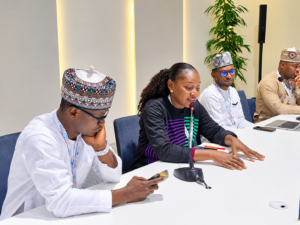
Dr. Boamah Kusi made the call at the launch of CASDIMedia, an initiative of the Climate and Sustainable Development Initiative, during a side event at the United Nations Climate Change Conference (COP31) in Antalya, Türkiye.
She argued that climate communication must move beyond the traditional knowledge-deficit approach, which assumes that providing information automatically leads to understanding and behavioural change.
“We need to go beyond just giving knowledge to people. We must engage them in ways that enable them to relate to whatever information we are providing,” she said.
According to her, people are more likely to understand and accept information when they can identify with the messenger, the language and the context in which the message is delivered.
She said communicators must therefore consider innovative approaches, including artificial intelligence, videos, billboards, flyers, television commercials and other creative platforms, to make climate information accessible and relatable to different audiences.
Dr. Boamah-Kusi cited the Jospong Group's waste management operations as an example of how community engagement and targeted communication could support environmental awareness and behavioural change.
She said the Group's waste management companies, which operate across the country, deliberately employ local people and involve communities in their operations to help residents understand the importance of proper waste collection and disposal.
She added that the Group also invested in capacity-building programmes for journalists, taking them on field visits to observe its operations and organising briefing sessions to explain the technical aspects of waste management.
The journalists also receive training in the use of social media and other communication platforms to help them disseminate information in different local languages.
Dr. Boamah-Kusi said such engagement was necessary to ensure that environmental communication did not exclude people because of their literacy levels, language or social circumstances.
“We should not just focus on those who are highly literate. We must take the entire population along, with specific messages for different groups of people,” she said.
She further emphasised the importance of understanding local cultures when communicating climate and environmental issues, particularly when engaging communities whose traditions and social practices differ from those of technical experts.
According to her, translating information into local languages alone is insufficient if communicators fail to understand the cultural values and practices of their target communities.
She said communication strategies must also deliberately include persons with disabilities and others with special needs.
“If you want to be inclusive, you have to be very deliberate,” she said, suggesting the use of songs, dances, visual materials, colourful billboards and accessible videos to reach people with different communication needs.
She noted that sustainability required a collective effort in which no group was left behind, adding that environmental messages must be designed to enable everyone to understand and participate in climate action.
CASDIMedia seeks to bridge climate information gap
At the same event, Muhammad Shamsuddin Ibrahim, the Founder and Strategic Lead of the Climate Alaramma Sustainable Development Initiative (CASDI), said CASDIMedia was established to bridge the information gap between climate and environmental policies, practical implementation and grassroots communities.
He said many environmental and climate-related concepts discussed at international conferences remained unfamiliar to ordinary people, despite their direct implications for their livelihoods.
He explained that the initiative sought to translate complex climate and environmental issues into simple local languages and familiar everyday experiences to encourage community participation and action.
“Our aim is to make climate local because, of course, it is a local issue, but it is often communicated through complex scenarios that make it difficult for people in grassroots communities to understand,” he said.
He said the initiative used storytelling and practical examples to help communities identify environmental problems around them and understand how their actions could contribute to addressing them.
One of its approaches involves using local-language storytelling and familiar characters, including animals, to explain environmental challenges and possible solutions.
He cited a series called Quote, which uses household and nature-related themes, with animals as characters, to discuss environmental issues in individual episodes.
The episodes identify problems affecting communities, engage experts to explain their causes and present practical actions residents can take to address them.
He said CASDIMedia was currently at the pilot stage, targeting communities in northern Nigeria, where Hausa is widely spoken.
The initiative is also exploring the use of Nigerian Pidgin English to reach a broader audience, with plans to consider Igbo and Yoruba and potentially expand into other languages beyond Nigeria.
He said the broader objective was to make climate information easier to understand and translate awareness into individual and collective environmental action.
“Government cannot do it alone. It is a collective responsibility because we all share the planet,” he said.
Comments