The EU's new digital border system, which requires fingerprints and photos alongside a passport scan, is set to be fully operational from Friday.
This was the deadline for the Entry/Exit System (EES) to be active at every Schengen border crossing point in all 29 participating countries.
The system was gradually introduced from October to strengthen security and ultimately make travel smoother, though some hiccups have delayed the rollout of every point.
There have been long queues at some European airports and warnings that delays could be worse during busy holiday periods.
What is EES, and where is it being introduced?
EES is a digital system designed to track when non-EU citizens, including those from the UK, enter and leave the Schengen Area.
This covers 29 European countries - mainly in the EU - where people can travel across without border controls.
It includes many popular destinations for UK travellers, such as France, Spain, Portugal, Italy and Greece.
Under the new system, fingerprints and a photo have to be registered.
EES will eventually replace the current system in which border officers stamp passports.
Will I need to use EES when I go on holiday?
When you first encounter EES will depend on where you're travelling to, and when. If you're flying, you will go through the process when you land at European airports.
The gradual introduction of EES began on 12 October, and the plan was to phase it in over six months.
There have already been hours-long queues at pinch points. Airports have warned that things could worsen during the upcoming holiday periods.
John and Phil, a married couple from Motherwell, queued for five hours after landing in Pisa Airport.
They arrived at 12:30 pm local time (11:30 am BST) after flying from Glasgow and didn't get through until the evening.
John has an Irish passport and waited in the queue for an hour, but his wife had to wait in a separate queue with other British passport holders.
John told the BBC: "When I came through, all the planes which had arrived in the hours before had all their suitcases unloaded from the carousel, left stacked on the concourse floor.
"There were several elderly people in those queues and, as you can imagine at this time, lots of children.
"Our government must do something about this," he said.
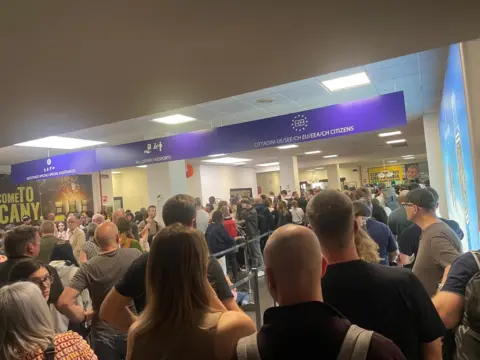
Travellers arriving at the popular ski destination of Geneva experienced long delays due to the system earlier this year.
Travel experts have told the BBC that the system has at times been blighted by IT issues, and long queues can form when travellers are unable to use it easily.
The European Commission has indicated that suspending EES checks to ease queues will be permitted during busy periods until September.
On Friday, not all airports in Europe will be switching the system on, including Milan and Lisbon.
What do passengers have to do to use EES?
The first time they use the new system, people from most non-EU countries will need to register biometric information and have their passports scanned.
Flight passengers will register at their destination airport.
But if you are crossing the English Channel by ferry from Dover, taking the Eurotunnel shuttle to France, or taking the Eurostar train, it will be done as you leave the UK.
At these places, most passengers will have to follow the instructions at special kiosks.
The machines will scan each passport, then take fingerprints and a photo.
Children under 12 won't have to provide fingerprints. Staff should be on hand to help.
The screen will also present travellers with four questions about their trip, such as confirming where they will be staying and that they have enough money.
However, at Eurotunnel, those questions will be asked by border officers at their discretion.
The EES registration will be valid for three years, with the details verified on each trip during that period.
At Dover, ferry passengers in coaches started using the new system in October. Other tourist traffic was initially meant to follow on 1 November.
However, people in cars have not yet begun using it, with no date confirmed.
Eurotunnel, which runs vehicle shuttles through the Channel Tunnel, is also introducing the EES in stages.
At the port of Dover and Eurostar's London St Pancras terminal, the questions will also not be presented on the machines during the introductory period. It will not be switched on on 10 April.
Big changes have had to be made at Dover. The port has reclaimed some land from the sea to create an additional processing area.
People will head to this new area, a mile from the ferry terminal, to do their EES checks.
Because the French border has in effect been moved to a coach processing building in this new area, coaches will be sealed after passengers have completed their checks. They will then drive over to catch their ferry.
The port's boss says groups of schoolchildren will be able to do some of their registration in advance, so they will only need to present their passports at the border.
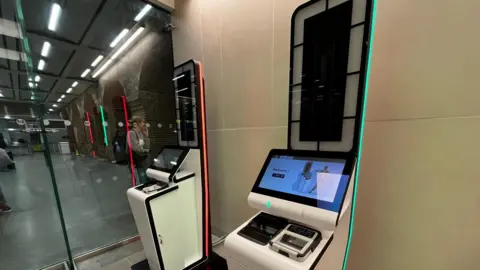
Eurostar has installed 49 EES kiosks in three areas around its London St Pancras terminal. Passengers will use them before presenting their ticket at the departures area.
However, checks are currently being completed manually by border officers rather than at the machines. Eurostar says it will bring in the kiosks "once the operational software and the activation timetable are confirmed and approved by the French Ministry of Interior".
Eurotunnel has installed more than 100 kiosks on both sides of the Channel.
Customers who are travelling in cars will be directed to drive up to a kiosk bearing their registration number and provide their biometric information there. Coach passengers will go through the process with a border officer.
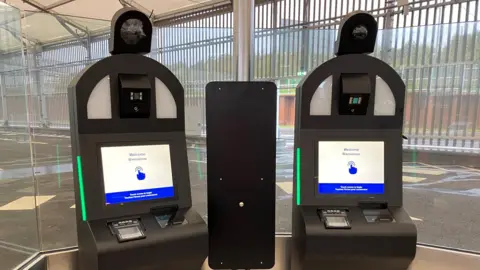
A mobile phone app has been developed to enable passengers to do part of the process before reaching the border. However, this isn't being widely used at the moment.
Concerns have repeatedly been raised that the extra couple of minutes it takes for each traveller to complete the registration process could lead to big queues, particularly at space-constrained Dover.
However, bosses at cross-Channel travel hubs hope that the decision to introduce EES gradually, instead of with a "big bang" start, will reduce the risk of disruption.
Eurotunnel chief executive Yann Leriche says there will be no "chaos" or queues at the Channel Tunnel and that his company is fully prepared.
Similarly, Eurostar hopes its decision to limit EES initially to some business travellers before expanding its use will help prevent queues.
What is ETIAS and when is that coming?
The EU is also introducing a new passport-linked visa waiver system, the European Travel Information and Authorisation System (ETIAS), which will build on the EES.
Citizens of non-EU countries who don't need a visa to enter the EU -including people from the UK - will be able to apply online for authorisation before they travel.
ETIAS isn't due to start until the end of 2026, but the final date has not yet been confirmed.
It will cost €20 (£17.47) per application, and will be valid for three years.
People aged under 18 and over 70 will need to apply, but won't have to pay.
Comments