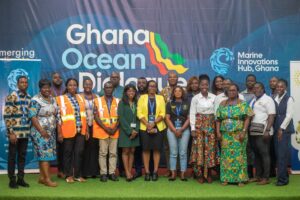
 Researchers, environmental regulators and civil society leaders have called for stronger enforcement of environmental laws, greater community participation and improved ocean data systems to protect Ghana’s marine resources and the livelihoods of coastal communities.
They warned that plastic pollution, illegal mining, coastal erosion, harmful fishing practices and declining fish stocks were undermining the health of the ocean and threatening the economic activities of thousands of people along the coastline.
The call was made at the Ghana Ocean Dialogue, organised by Emerging Climate Frontiers (ECF) and the Ghana Marine Climate Innovation Hub, in partnership with the University of Cape Coast (UCC), in Cape Coast on October 15, 2026.
Held under the theme “Shaping Our Blue Economy,” the dialogue brought together researchers, policymakers, environmental regulators, civil society representatives and youth advocates to explore ways of protecting Ghana’s marine environment while expanding the economic opportunities it offers.
Land-based pollution threatens coastal communities
Delivering a solidarity message, Prof. Simon Mariwah, Provost of the College of Humanities and Legal Studies at UCC, said plastic pollution along the coast could not be addressed without tackling waste disposal practices in inland communities.
He noted that much of the plastic washed ashore did not originate from beachgoers or fishermen but from communities farther inland.
Participants also identified illegal small-scale mining, popularly known as galamsey, as a major threat to marine ecosystems. Mining activities can introduce heavy metals and sediment into rivers that eventually flow into the sea.
Other concerns included the use of banned chemicals such as DDT and relabelled toxic agrochemicals in fishing, alongside shoreline erosion, rising sea levels and overfishing.
These challenges, they said, were damaging beaches, threatening homes and heritage sites, reducing fish catches and putting pressure on the livelihoods of fishing communities.
Experts call for stronger ocean governance
Speaking on behalf of the Centre for Coastal Management, Dr Dorothy Khasisi Lukhabi said Ghana’s ocean future depended on deliberate action and the effective implementation of policies designed to build a resilient blue economy by 2035.
She called for stronger coordination among institutions, public accountability and evidence-based decision-making, as well as the protection of natural coastal defences.
The dialogue proposed a sustainable ocean economy framework built around five pillars: Blue Wealth, Blue Health, Blue Knowledge, Blue Finance and Blue Equity.
The framework seeks to connect economic opportunities from marine resources with environmental protection, research, financing and fairness in the distribution of benefits.
Edem Alipo, a Carbon Dioxide Removal Fellow at ECF, also launched the Ghana Marine Climate Innovation Hub, which aims to bridge the gap between academic research and policymaking.
Community participation key to conservation
During a panel discussion moderated by Prisca Kuworde, Strategic Coordinator at ECF, participants stressed that environmental policies would be difficult to implement without the trust and active involvement of coastal communities.
The panel included Dr. Mabel Anim, a coastal geomorphologist at UCC; Prof. Benjamin Kofi Nyarko, Principal Investigator for the Ghana Climate University Network; Monica Tampuri, Executive Director of Banyani; and Priscilla Djaba, Programmes Officer at the Environmental Protection Authority (EPA).
Prof. Nyarko said indigenous traditions, including spiritual and customary practices associated with the sea, should be incorporated into modern coastal governance.
He argued that direct engagement and clear communication were necessary to help communities understand the purpose of environmental regulations and their role in protecting livelihoods.
Panellists observed that resistance to conservation initiatives often arose from fears of losing income, unfulfilled promises or a lack of consultation.
Tampuri called for greater public education on sustainable practices and the involvement of schoolchildren in ocean stewardship. She also urged researchers to communicate their findings in local languages and ensure that communities hosting research projects received practical benefits.
Caution urged over emerging climate technologies
Dr. Anim cautioned that emerging climate interventions, including ocean alkalinity enhancement — a proposed method of increasing the ocean’s capacity to absorb carbon dioxide — should undergo rigorous feasibility assessments before being introduced.
She stressed the need to consider local conditions and combine scientific evidence with indigenous knowledge when evaluating such interventions.
The discussion highlighted the importance of ensuring that climate solutions do not create additional risks for coastal ecosystems or communities whose livelihoods depend on the sea.
Better data and financing needed
Djaba outlined the EPA’s efforts to develop data vulnerability hubs and collaborate with academic institutions on a shared geospatial database.
The proposed data systems are expected to strengthen evidence-based policymaking and support access to carbon markets.
On financing, Prof. Nyarko and Dr. Anim called for a coordinated ocean financing framework that could bring together resources from different sources.
They identified opportunities through the Green Climate Fund, carbon credits from mangrove conservation, and blue bonds or loans offered through financial institutions.
They emphasised that financing arrangements should ensure that coastal communities receive a fair share of the benefits, with recognised community leaders involved in the process.
Waste management and youth employment
Obed Osabutey of the National Disaster Management Organisation called for expanded training in sustainable waste management to help communities reduce pollution entering rivers and the sea.
Prof. Nyarko proposed youth-led plastic collection initiatives that could create income opportunities while helping to clean coastal areas. He also urged the EPA to intensify action against the illegal relabelling and sale of toxic chemicals used in fishing.
Tampuri suggested that collected plastic waste could be converted into artistic products for sale, creating opportunities for local enterprise while reducing pollution.
Participants agreed that protecting Ghana’s blue economy would require more than national policies and institutional commitments. They called for practical action at the community level, stronger enforcement of environmental regulations and greater collaboration among government agencies, researchers, businesses and coastal residents.
They stressed that a resilient ocean economy would depend on protecting marine ecosystems while ensuring that the people whose livelihoods rely on the sea participate in decisions and benefit from conservation efforts.
Comments