MTN Ghana has reaffirmed its commitment to supporting small and medium-sized enterprises (SMEs) with business management training, digital solutions and post-training monitoring to help entrepreneurs improve their operations, create jobs and contribute to economic growth.
The commitment was highlighted at the graduation of participants in the MTN NOVA Business School's Mini MBA programme, a 13-week capacity-building initiative under its year-long SME Accelerate programme.
Mohamed Abubakar Siddiq, Senior Manager for SME Sales, Business Partnership and Fibre Broadband at MTN Ghana, said the programme was designed to address business management gaps identified through the company’s SME clinics.
Strategically, the Mini MBA is part of the year-long SME Accelerate programme that we have put together. Throughout the journey, we have identified certain gaps within the SMEs through what we call SME clinics,” he said.
He explained that while the SME clinics typically lasted two days, the Mini MBA provided more extensive training in strategic financing, business sustainability, bookkeeping and digitalisation.
This is a build-up on the SME clinics that we had. We are doing capability building to bring them together for a longer period of 13 weeks so that they can be taught strategic financing, sustainability, how to keep their books and how to adopt digitisation as part of their business for them to grow,” Siddiq said.
The programme was organised in collaboration with NOVA Business School Africa to help participating businesses address identified weaknesses and develop the skills needed to scale their operations.
 According to Siddiq, MTN Ghana organised six SME clinics in 2026, through which businesses were assessed and participants identified for additional support based on their needs.
He said the Mini MBA was open to the general public, with particular attention given to entrepreneurs who had participated in the SME clinics. The graduates were then organised into three groups comprising men, women and a mixed cohort.
MTN to track impact on businesses
Siddiq said MTN Ghana would work with its partners to monitor participants after graduation to ensure they applied the knowledge acquired during the programme.
We are going to monitor them and ensure that whatever they have learnt, they are really putting it into practice so that all the good things they have learnt will not fall through the cracks,” he noted.
NOVA Business School Africa is responsible for following up on Mini MBA participants, while SMEGA supports monitoring for businesses that participated in the SME clinics.
Siddiq said MTN Ghana intended to continue the Mini MBA annually, describing the 2026 graduation as the culmination of the year-long SME Accelerate programme.
MTN urges entrepreneurs to apply lessons
Angela Mensah-Poku, Chief Enterprise Business Officer of MTN Ghana, challenged the graduates to translate the knowledge gained into practical improvements in their businesses rather than treating the graduation ceremony as the end of their learning journey.
She said SMEs needed to strengthen their capacity to respond to changing customer expectations, increased competition, digital disruption and economic pressures.
At MTN, we believe that when SMEs succeed, communities succeed, industries thrive and economies become stronger. Small and medium-sized enterprises are the backbone of economic activity,” she said.
Mensah-Poku explained that business support should go beyond providing technology and productivity tools to include the knowledge and skills entrepreneurs need to build sustainable enterprises.
She encouraged graduates to implement their learning, share knowledge with their teams, create employment and mentor other entrepreneurs.
As you return to your businesses, take your teams with you, share the knowledge, implement your ideas, create jobs, mentor other entrepreneurs and continue to contribute to a stronger private sector,” she urged.
She added that MTN Ghana measured its contribution not only by the products and services it offered but also by the growth of the businesses it supported.
Graduate cites improvements in business management
One of the graduates, Nana Abenaa Oforiwa Kwao-Adotey, founder of SinceShea, a beauty and personal care brand producing eco-friendly skin and hair care products using shea butter, black soap and essential oils, said the programme had changed her approach to financial management, digital marketing and team building.
She said the training helped her identify weaknesses in her business, particularly in bookkeeping and the use of digital tools to measure performance.
Coming on board, I thought I was doing the best, but I wasn't seeing results in terms of my numbers and also my statistics. But coming on board, I realised that there was so much I wasn't doing,” she said.
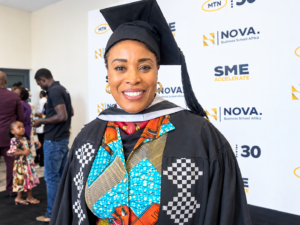
Kwao-Adotey said she had learnt the importance of keeping accurate financial records to understand her business performance and make informed decisions.
I have learnt to keep the right records because if I don't know my numbers, then obviously I cannot tell where my business is going to,” she said.
She also identified branding and digital marketing as areas requiring further investment, explaining that the programme had encouraged her to go beyond an earlier rebranding exercise.
As part of her 90-day business improvement plan, she said she had begun developing a comprehensive catalogue for her business WhatsApp page and working to optimise her website.
The training also changed her approach to recruitment, particularly the tendency among some women entrepreneurs to employ family members and friends without adequately assessing their skills.
She said she now recognised the importance of recruiting people with the right competencies to achieve business objectives.
I'm working out of this programme better than I came on board, and my business has already started seeing growth in the right areas,” she said.
Building a stronger SME sector
The SME Accelerate programme reflects MTN Ghana's efforts to combine technology with practical business education to help entrepreneurs strengthen their operations.
Through training in financial management, sustainability, digital adoption, marketing and leadership, the initiative seeks to equip business owners with the tools to improve competitiveness and build more resilient enterprises.
The programme's emphasis on post-training monitoring is also intended to help participants turn classroom lessons into practical changes that can support long-term business growth.
For entrepreneurs such as Kwao-Adotey, the next phase will involve implementing their business improvement plans, strengthening internal systems and using digital tools to reach customers and manage operations more effectively.
Comments