By Albert Amekudzi
The world is entering an era where crises are no longer exceptions; they are becoming the norm. The Russia-Ukraine war exposed vulnerabilities in global food, fertilizer, energy, and supply chains. The ongoing tensions and military confrontations involving Iran have once again demonstrated how quickly global energy markets can be disrupted. The COVID-19 pandemic revealed the fragility of international logistics systems. Climate change continues to threaten food production and water security across continents.
For countries like Ghana that basically depend heavily on imports and global supply chains, every geopolitical shock quickly becomes an economic shock. Ghana is not immune. While Ghana has rightly embarked on the Ghana Accelerated National Reserve Accumulation Policy (GANRAP), aimed at building significant gold reserves, the country must recognize that national resilience cannot be built on gold reserves alone.
Gold reserves provide monetary stability. However, they do not feed citizens during food shortages. They do not fuel industries during energy disruptions. They do not supply critical mining equipment when international supply chains collapse. The time has come for Ghana to think beyond traditional economic management and adopt a comprehensive National Strategic Reserve Framework that protects the country against future global shocks.
The New Global Reality: Strategic Reserves Are the New National Insurance
Many countries have learned hard lessons from recent crises. The United States maintains one of the world's largest Strategic Petroleum Reserves. China has built massive stockpiles of grain, rare earth minerals, fuel, and industrial inputs. India maintains strategic food reserves capable of supporting hundreds of millions of people. Saudi Arabia, the UAE, Singapore, and South Korea have invested heavily in strategic storage and domestic industrial capabilities. These countries understand a simple principle: National resilience is not built during a crisis. It is built before a crisis. Countries that wait until supply chains break down are often forced to pay exorbitant prices, borrow heavily, or suffer severe economic disruptions. Ghana cannot afford bending its knees always in times of crisis.
Gold Reserves Are Necessary but Not Sufficient
The decision to accumulate gold reserves is commendable. Gold strengthens confidence in the national currency, improves foreign reserve positions, and provides a hedge against global financial instability.
However, if a global conflict disrupts food imports, fertilizer supplies, petroleum shipments, pharmaceutical supplies, or mining equipment procurement, gold alone will not solve those challenges. A resilient economy requires reserves across multiple strategic sectors.
Building a National Strategic Reserve Architecture
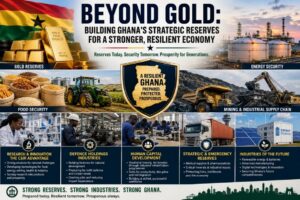
Ghana should consider establishing five interconnected strategic reserve pillars.
- National Food Security Reserve
Food security is national security. Ghana should establish modern strategic grain reserves capable of sustaining the population during prolonged supply disruptions. These reserves should include Maize, Rice, Sorghum, Millet, Soybeans, and Vegetable oils. We have enough land, technology and water to do this. We can have the Ministries of Food and Agriculture, Environment, Science and Technology and Interior collaborate to get this started based on research and science. Storage facilities should be modernized using advanced preservation technologies to minimize losses. Additionally, strategic fertilizer reserves should be maintained to support domestic food production during global supply disruptions. The objective should be clear: No Ghanaian should face food insecurity because of a war occurring thousands of kilometers away.
- Strategic Energy Reserve
Energy remains the lifeblood of modern economies. Despite Ghana's growing oil and gas sector, the country remains exposed to international price volatility and supply disruptions. Ghana should establish strategic petroleum reserves, diesel reserves, aviation fuel reserves, LPG reserves and emergency gas storage systems. A reserve target of six to twelve months for critical fuel products would significantly enhance national resilience. Not the five to six weeks reserve we were told when the US-Israel-Iran war started in February. Simultaneously, investments in renewable energy storage technologies should be accelerated. The future strategic reserve is not only fuel in tanks but also electricity stored in batteries.
- Mining and Industrial Supply Chain Reserve
Mining contributes significantly to Ghana's export earnings and fiscal revenues. Yet many critical mining inputs are imported. A disruption in global logistics could affect explosives, industrial chemicals, drilling equipment, heavy machinery parts, conveyor systems and electrical components. Ghana should work with mining companies to establish strategic in-country factories and stockpiles of critical mining inputs. This would ensure continuity of operations even during major international disruptions. The same principle should apply to other strategic industries, including manufacturing, telecommunications, healthcare, and transportation.
- National Critical Minerals and Industrial Metals Reserve
As the global energy transition accelerates, critical minerals are becoming strategic assets. Ghana possesses significant mineral resources, including Gold, manganese, bauxite, lithium and iron ore prospects. Rather than exporting all production immediately, Ghana should consider retaining portions of strategic minerals as national reserves. Countries that control critical minerals will increasingly shape the future global economy. The next generation of economic power may not be determined solely by oil reserves but also by control over battery minerals, industrial metals, and rare earth supply chains.
- Strategic Medical and Emergency Reserve
The COVID-19 pandemic exposed severe weaknesses in global medical supply chains. Ghana should maintain strategic reserves of essential medicines, vaccines as well as strengthen the Centre for Scientific Research into Plant Medicine, personal protective equipment, emergency medical equipment and water treatment chemicals. Every crisis eventually becomes a public health challenge. Prepared nations save lives and reduce economic losses. Let’s build a strong pharmaceutical industry based on plant medicine which we are all know. Let’s have a national policy and strategic target for medical and emergency reserve. It will save us all whether we are NDC or NPP because medical emergency does not know who NDC is or NPP. Let’s work for our greater good and not leap service to our nation and political parties.
Reviving Defence Holdings as a Strategic Industrial Engine
Perhaps the most transformative opportunity lies in rebuilding and modernizing the Ghana Armed Forces' Defence Industries Holding structure. Historically, military-linked industries around the world have often served as catalysts for industrial development. Examples include South Korea, Israel, Turkey, Singapore, Iran and China. In these countries, defence-linked industries became centers for innovation, manufacturing, engineering, and technology development. Ghana should consider establishing Defence Holdings factories focused on Agricultural Equipment Manufacturing for tractors, irrigation systems, harvesting equipment and farm implements. Industrial Fabrication for steel products, mechanical components and industrial machinery. Energy Technologies for solar systems, battery assembly and power storage solutions. Advanced Manufacturing for drones which can be learnt from Iran, robotics, sensors and communication systems. Strategic Logistics for vehicle assembly, fleet maintenance and emergency transport systems.
These industries would serve both civilian and defence purposes while creating jobs, transferring technology, and reducing import dependence.
Building the Industries of the Future
The next global economic competition will not be won by countries that simply export raw materials. It will be won by countries that master strategic technologies. Ghana should identify and invest in future industries such as Artificial Intelligence, drone technology, advanced materials, battery manufacturing, semiconductor assembly, cybersecurity, defence technologies and renewable energy systems.
A dedicated Strategic Industries Development Fund could be established using portions of mineral revenues, sovereign wealth resources, and public-private partnerships.
Financing the Strategic Reserve Agenda
The immediate question is obvious: How will Ghana pay for all this? The answer lies in a phased approach. Funding sources could include mineral royalties, sovereign wealth mechanisms, gold reserve-backed financing, public-private partnerships, pension fund investments, infrastructure bonds and development finance institutions. At least Ghana is not under any sanction like Iran so we should be able to do this and not just keep talking as we always do. Strategic reserves should be viewed not as expenditures but as national insurance policies. Countries willingly pay insurance premiums because they understand the cost of being unprepared. The same principle applies to national resilience.
A New National Vision
For decades, economic discussions in Ghana have focused on growth. Growth is important. However, the future belongs to countries that combine growth with resilience. The most successful nations of the twenty-first century will not necessarily be those that avoid crises. They will be those that are best prepared for them. The Ghana Accelerated National Reserve Accumulation Policy is an important first step. But the next phase must be broader and more ambitious. Ghana must build food reserves. Ghana must build energy reserves. Ghana must build industrial reserves. Ghana must build strategic technologies. Ghana must build future industries. Above all, Ghana must build national resilience.
The question is no longer whether another global crisis will occur. The question is whether Ghana will be prepared when it does. History suggests that nations which prepare during periods of relative stability emerge stronger from periods of uncertainty. The time to prepare is now.
Comments