
Ghana is stepping up efforts to transform its cashew industry from one largely focused on the export of raw cashew nuts into a more value-added and commercially sustainable sector, the Tree Crops Development Authority (TCDA) has said.
Dr. Rich Kofi Kofituo, Deputy Chief Executive Officer of the TCDA in charge of Operations, said the Authority was implementing measures to strengthen regulation, improve farmer incomes, promote local processing and ensure greater value was retained within Ghana.
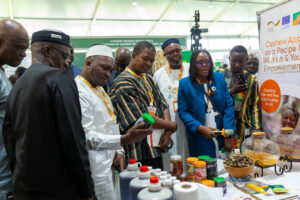
He was speaking to the media after the opening of the three-day 2026 African Cashew Alliance (ACA) Annual Conference and expo in Accra, being held under the theme “Sustainable Cashew Supply through Policy, Investment and Partnership.”
According to Dr. Kofituo, the TCDA was established under the Tree Crops Development Authority Act, 2019 (Act 1010), to regulate and sustainably develop six major tree crops—cashew, coconut, oil palm, rubber, mango and shea.
He said although the Authority had existed since 2019, its activities became more prominent from 2024, prompting intensified efforts to create public awareness about its mandate.
The authority by an Act of Parliament, Act 1010, is in charge of regulating and also sustainably developing six of our key cash crops in Ghana, which are cashew, coconut, oil palm, rubber, mango and shea,” Dr. Kofituo mentioned.
Focus on value addition
Dr. Kofituo said a major priority of the Authority was to reduce Ghana's dependence on raw cashew exports by promoting domestic processing and value addition.
He noted that opportunities existed beyond the cashew nut itself, particularly in the utilisation of the cashew apple, much of which he said was currently left on farms after harvesting.
His Excellency the President John Dramani Mahama's concentration or effort is to look at how we can add value to the raw cashew nut and even process beyond the cashew nut to the apple,” he said. Addeing that “Ninety per cent of the cashew apple that is being used in this is just left on the farm and unattended to.”
Dr. Kofituo said the Authority was therefore encouraging investment in processing and the development of products from both the cashew nut and apple.
He further added that Ghana was also putting in place mechanisms to reserve a proportion of cashew production for domestic processors, with the specific percentage to be determined by the appropriate committee of the TCDA Board.
Farmers at centre of regulation
Dr. Kofituo stressed that the drive for value addition must directly benefit farmers, who remain the foundation of the cashew value chain.
He said the TCDA had introduced a minimum pricing mechanism aimed at protecting farmers from unfair pricing practices and ensuring that they received profitable returns for their produce.
The farmer is at the centre of the minimum pricing mechanism that is being done at the Tree Crop Development Authority so that people don't take advantage of what has been happening previously,” he said.
He explained that the mechanism brought together actors in the sector to determine prices in a manner that provides farmers with a reasonable return.
The Authority is also promoting the use of improved planting materials, with Dr. Kofituo disclosing that at least 25,000 improved cashew planting materials had recently been distributed to farmers in cashew-growing areas.
He said farming inputs and protective equipment had also been provided to producers.
Traceability system
Dr. Kofituo said Ghana had also begun strengthening traceability in the cashew sector as part of efforts to improve regulation.
We started with traceability issues. So now we want to know if you are farming cashew from a particular community, maybe Sampa, and it's coming to Accra. We even know the farmer that gave you that cashew,” he said.
According to him, the system would allow the Authority to track cashew from the farm through the various stages of the supply chain to the port.
He said the next stage would be to use the traceability system to direct a specified proportion of cashew to local processors before the commodity could be exported.
That is what we want to get to so that we add value before the cashew goes out of this country,” he said.
Support for small-scale processors
Dr. Kofituo said government’s approach would not be limited to large industrial processing companies, noting that small and artisanal operators also play an important role in the cashew value chain.
He said the TCDA was working to improve their efficiency through technology while helping them become more attractive to financial institutions.
“What really lacks at their level is financing,” he said, adding that the Authority was helping small businesses improve their bookkeeping, operational systems and environmental, social and governance (ESG) standards.
He observed that such measures would make small-scale processors more “bankable” and better positioned to access grants and financing from banks and other institutions.
Government calls for transformation of cashew industry
Speaking on behalf of the Minister of Food and Agriculture, Eric Opoku, Deputy Director at the Ministry, Dr. Harry Bleppony, noted that Africa needed to move beyond the export of raw cashew nuts and capture a greater share of the value generated by the industry.
He said cashew had become an important source of rural livelihoods, employment and foreign exchange across the continent.
“Africa produces a significant proportion of the world's cashew nuts but captures a smaller proportion of the value generated from the processing and downstream activities,” Dr. Bleppony said.
He said the situation needed to change, with African countries focusing on productivity, quality, processing and value retention.
“Our ambition must be to move from being predominantly producers and exporters of raw cashew nuts to becoming globally competitive producers of high-quality cashew products,” he said.
Dr. Bleppony said Ghana had significant potential to develop its cashew industry, particularly in areas such as Bono East, Ahafo and the Savannah regions.
However, he cautioned that increasing production alone would not be enough.
Our objective is to build a productive, competitive, sustainable, and value-added cashew industry,” he said.
He identified improved planting materials, good agricultural practices, extension services, better harvesting and post-harvest handling, local processing, market development and climate resilience as key areas requiring attention.
Processing as a rural development opportunity
Dr. Bleppony said greater investment in cashew processing could also support rural economic development by creating jobs for women and young people.
Processing should not be viewed only as an industrial activity. It is also a rural transformation opportunity,” he said.
He called for investment in processing facilities, energy and water infrastructure, storage, warehousing, packaging, logistics, quality laboratories, technology and research.
He further urged stronger collaboration among African research institutions, investors, regulators, development partners and industry players.
According to him, the African Cashew Alliance provides an important platform for producing countries to collaborate on research, planting materials, extension, quality standards, pest and disease management, processing technologies, market intelligence and trade.
He also highlighted the African Continental Free Trade Area as an opportunity to expand markets for processed agricultural products and strengthen regional value chains.
From potential to prosperity
Dr. Bleppony said government remained committed to creating an enabling environment for the sustainable development of Ghana’s tree-crop sectors.
He said the government’s focus would increasingly be on productivity, quality, sustainability, value addition and competitiveness.
“Africa has the resources, farmers, entrepreneurs, markets, and human capital required to build a globally competitive cashew industry. What we need is stronger coordination, greater investment in technological innovation, and a shared commitment to value addition,” he said.
He urged participants at the three-day conference to translate discussions into concrete actions capable of strengthening Africa’s cashew industry.
“Let us use this conference to strengthen the partnership, exchange knowledge, and agree on practical actions that will move Africa's cashew industry from potential to prosperity,” Dr. Bleppony said.
Comments