By Kofi Ahovi
The Ghana Atomic Energy Commission (GAEC) has intensified efforts to deepen public understanding of nuclear energy, with officials highlighting the safety features and flexibility of Small Modular Reactors (SMRs) as Ghana advances plans to introduce nuclear energy into its power generation mix.
Speaking to journalists during a familiarisation tour of selected facilities at the GAEC, Manager of the Localization and Stakeholder Support Centre at Nuclear Power Institute-GAEC, George Kofi Appiah, said modern nuclear technology had evolved significantly, with multiple layers of safety systems designed to prevent and manage accidents.
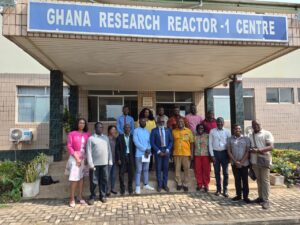
The journalists visited the Energy Exploration (E2) Centre - Africa's first small modular reactor (SMR) control room simulator, the Radioactive Waste Management Centre and the Ghana Research Reactor-1 as part of efforts to help the media better understand Ghana’s nuclear power programme and the operations of the GAEC.
At the E2 Centre, Appiah demonstrated the operation of a nuclear power plant control room simulator, which he said replicates the systems and processes used to operate an actual nuclear power plant.
It actually has a simulator that makes the control room of a nuclear power plant. It is not a real plant, but it mimics the control room,” he explained.
According to him, the simulator was donated to Ghana by the United States Department of State to support nuclear energy development and capacity building in Africa.
He said the facility provides an opportunity for professionals, students and members of the public to gain practical knowledge about how nuclear power plants are operated.
Everything that happens here is a direct replica of what happens in the nuclear power plant control room. We are calling all of you to come and experience how a nuclear power plant is operated from a control room,” Appiah said.
He added that the facility could be accessed by the public, including individuals and organised groups, subject to prior notification to the Centre.
Nuclear power is safe
 Appiah sought to allay public concerns about the safety of nuclear energy, particularly in the wake of major nuclear accidents such as Fukushima in Japan.
He noted that Japan, despite suffering the atomic bombings of Hiroshima and Nagasaki and the Fukushima nuclear accident in 2011, continues to operate and restart nuclear reactors.
Nuclear power is safe,” he said, arguing that the continued reliance on nuclear energy by countries that have experienced nuclear-related incidents demonstrates the importance of the technology to modern energy systems.
He explained that the Fukushima accident was triggered by a combination of a major earthquake and a subsequent tsunami.
According to him, the Fukushima reactors initially responded appropriately to the earthquake by shutting down. However, the tsunami subsequently disabled diesel generators that were required to pump cooling water into the reactors.
When the nuclear power plant shuts down, because the temperature is high inside the reactor vessel, the temperature does not disappear all of a sudden. You have to take measures to take away the heat,” he explained.
Appiah said the failure of the backup cooling systems led to a build-up of hydrogen, which contributed to explosions at the facility.
He stressed, however, that modern reactor technologies incorporate additional safety mechanisms designed to address such scenarios.
What I have explained here is that the new nuclear systems have safety systems. We have the decay heat removal system and the emergency cooling system, which kick in when a situation happens,” he said.
He said some modern designs also incorporate passive safety systems that rely on natural forces such as gravity, reducing dependence on external power or human intervention during emergencies.
SMRs offer flexibility
Appiah said Ghana could benefit from the flexibility offered by Small Modular Reactors as the country considers the appropriate nuclear technology for its energy needs.
Unlike conventional large reactors, which can generate around 1,000 megawatts or more and require extensive construction before being connected to the national grid, SMRs can be deployed in smaller units.
The first unit, you put it on the grid and then continue building until you are done with six or 12. For a large reactor, you have to wait until you have finished the construction and commissioning before you put that 1,000 or 1,200 megawatts on the grid,” he said.
He explained that the modular approach could also make maintenance easier because individual units could be taken offline while others continue generating electricity.
When it comes to maintenance, you do not have to shut down a large plant. You shut down one module, you do the maintenance, and the other 11 are running and giving you power,” Appiah said.
Grid stability
He also highlighted the importance of considering the capacity of Ghana’s electricity grid when selecting the size of a nuclear power plant.
Appiah said international grid-planning principles generally seek to ensure that a single generating unit does not account for an excessively large share of total electricity generation, as the sudden loss of such a unit could destabilise the grid.
He said a large 1,000-megawatt reactor could pose challenges if Ghana’s grid capacity is not sufficiently robust to absorb its output and withstand its sudden removal.
If you have a Small Modular Reactor producing about 300 megawatts, or let’s say 400 megawatts, if you put that on the grid, you are actually going to fall within the safe limits that we are talking about,” he said.
He stressed that grid readiness would therefore be a critical consideration in Ghana’s nuclear power planning.
If you are going to add another 1,000 megawatts to the pool that we already have, we need the grid to be able to absorb it,” he said.
Regional capacity building
Appiah also disclosed that the E2 Centre is being used to build nuclear-related technical capacity beyond Ghana.
He said personnel from countries including Nigeria, Kenya and Rwanda had participated in training programmes at the facility.
We had participants from Nigeria, Kenya and, if I am not mistaken, Rwanda. They came here to train,” he said.
He added that discussions were underway to explore virtual training programmes to help participating countries maintain and further develop the knowledge acquired at the Centre.
Background
Ghana has been exploring nuclear power as a long-term option for diversifying its electricity generation mix and meeting rising energy demand. The Nuclear Power Ghana (NPG) is playing a key role in supporting the country’s nuclear power development agenda, including research, technical capacity building, public education and stakeholder engagement.
The familiarisation tour, facilited by NPG, forms part of efforts to improve public understanding of nuclear technology and provide journalists with first-hand knowledge of the institutions and facilities supporting Ghana’s nuclear programme.
The NPG maintains that public education and stakeholder engagement are critical to building confidence in nuclear technology, particularly as Ghana considers the deployment of new-generation reactors with enhanced safety features.
The tour of the Radioactive Waste Management Centre also provided journalists with an opportunity to understand how radioactive materials and waste are handled, managed and controlled as part of Ghana’s nuclear safety framework.
For Appiah, sustained public education remains essential as Ghana moves closer to decisions on the technology and infrastructure required for nuclear power generation.
It is important for the public to understand and appreciate what we are doing,” he said.
Comments