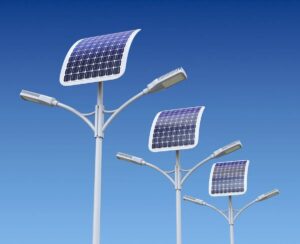
The government is set to replace conventional, grid-powered streetlights with solar-powered systems nationwide, in a move aimed at improving the reliability of public lighting and reducing the impact of power supply interruptions on street illumination.
Minister of Roads and Highways, Governs Kwame Agbodza, said the government had taken a decision to make solar technology the standard for streetlights installed under new road projects and replacement programmes.
He explained that unlike grid-connected streetlights, solar-powered units could operate independently, meaning a fault affecting one installation would not necessarily plunge an entire stretch of road into darkness.
Government has taken a decision to replace all streetlights with solar. With solar, even if one is damaged, the others can work,” Agbodza said.
According to the Minister, the government would no longer install main-grid-powered streetlights under new road projects, making the transition to solar a key component of its public lighting strategy.
He said the Minister for Energy and Green Transition, John Abdulai Jinapor, was leading the nationwide transition.
Accra's streetlighting challenge
The announcement comes against the backdrop of persistent concerns over the state of streetlighting in Accra, where several major roads and communities continue to experience dark stretches at night.
In April 2026, the Greater Accra Regional Minister, Linda Ocloo, directed Metropolitan, Municipal and District Chief Executives to urgently address poor street lighting across the region after her office received repeated complaints about dark areas.
She said that despite efforts to procure and distribute streetlights to assemblies, several communities remained poorly lit and stressed that adequate street lighting was important for public safety and the government's 24-hour economy policy.
The problem has also been evident along major transport corridors. In June, motorists and pedestrians using the Achimota Forest stretch of Accra raised concerns over non-functioning streetlights, with large sections of the road reportedly left in darkness at night.
The situation has broader road-safety implications. The National Road Safety Authority has previously warned that non-functional or unavailable streetlights leave some high-risk locations in darkness, increasing the vulnerability of motorists and pedestrians to road crashes.
Maintenance remains a key concern
The government's proposed solar transition is also expected to address some of the maintenance challenges associated with conventional streetlights.
Under the existing system, street lighting can be affected by electricity supply interruptions, damaged cables, faulty switching systems and other infrastructure problems. The Electricity Company of Ghana (ECG) has guidelines covering the installation and maintenance of streetlights connected to its network, including requirements for appropriate switching systems and properly sized cables.
ECG's current operational updates also show that parts of the Accra distribution network continue to experience cable, transformer and other infrastructure faults, although these relate primarily to electricity supply rather than streetlights themselves.
The solar model could therefore provide greater independence from the national grid, particularly in areas where power interruptions are frequent.
However, the effectiveness of the programme will ultimately depend on the quality of the solar installations, battery capacity, regular maintenance, replacement of damaged panels and batteries, and protection against vandalism.
Traffic-light failure
Agbodza also addressed the recent failure of traffic lights at the Tema end of the Accra-Tema Motorway, saying the problem was not caused by ECG as initially suspected.
He said investigations revealed that underground cables supplying the traffic-light system had been removed.
The government, he explained, would therefore have to engage a new contractor to completely rewire the system before the traffic lights could be restored.
The development highlights a wider challenge facing public road infrastructure: installing new equipment alone may not be sufficient unless adequate systems are put in place for maintenance, monitoring and protection against damage and vandalism.
Solar transition
The government's decision represents a significant shift in Ghana's approach to public lighting, with solar expected to become the preferred technology for new installations and replacements.
Solar streetlights could reduce the dependence of public lighting on the national electricity grid while providing individualised lighting points that can continue operating even when grid power is unavailable.
The success of the policy, however, will depend on how quickly existing faulty streetlights are replaced, the standard of equipment deployed and whether the government and local authorities establish sustainable maintenance arrangements.
For residents and motorists in Accra, where dark stretches of major roads remain a concern, the immediate test will be whether the policy translates into more consistently illuminated roads and safer night-time travel.
Comments