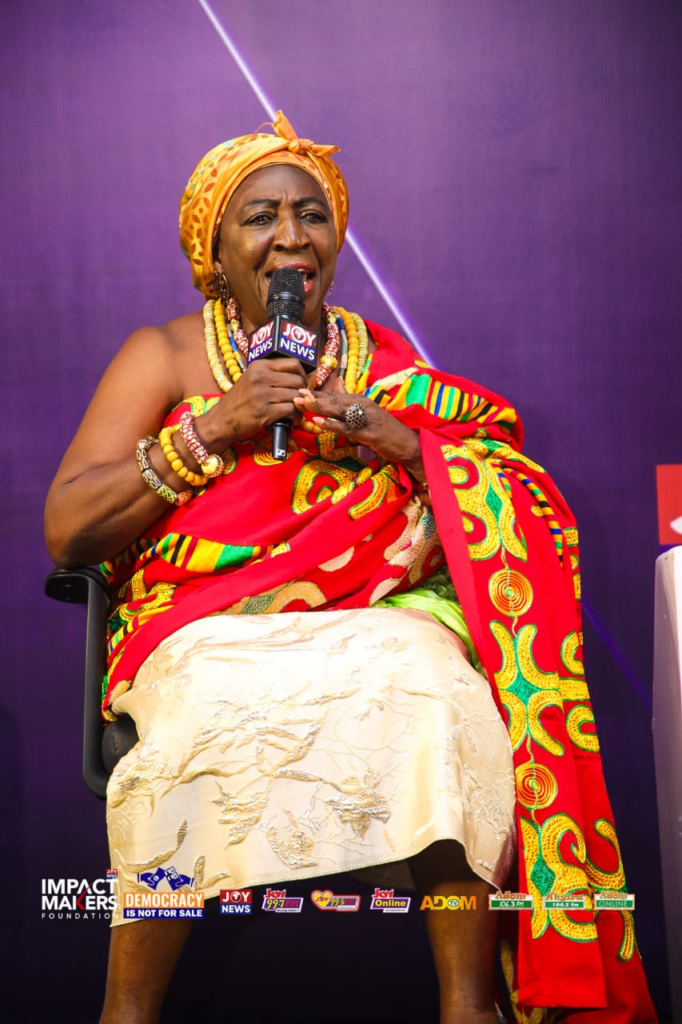
The Queen Mother of Ho-Dome in the Asogli Traditional Area in the Volta Region, Mama Atrato II, has made explosive allegations of widespread vote-buying in Ghana's Council of State election, claiming some delegates accepted GH¢5,000 each in exchange for their votes during the selection process in the Volta Region.
Speaking at the JoyNews' Impact Makers Foundation "Democracy Is Not for Sale" public forum held in Ho on Friday, July 31, the traditional leader described her experience as a former Council of State aspirant in the Volta Region as deeply disappointing, arguing that money has become the determining factor in securing public office rather than competence or commitment to public service.
According to her, the monetisation of the electoral process has deprived the Volta Region of effective representation and contributed to its slow pace of development.
When I went to bother myself to stand for Council of State [election], what is happening there is so pathetic and so sad because my Volta Region is underdeveloped," she told the audience.
Mama Atrato II alleged that some delegates who participated in the Council of State election were each paid GH¢5,000 to cast their votes for particular candidates.
She further claimed that the delegates were transported together and accommodated at a hotel in Sogakope before the election.
"Delegates were taking GH¢5,000 to vote for Council of State," she alleged.
"The disgraceful thing is they were parked in a car and sent to a Sogakope Hotel. They spent the weekend there. They were told to eat whatever they wanted."
The Queen Mother claimed that approximately 40 delegates benefited from the alleged payments.
In contrast, she said she could only provide delegates with GH¢200 each to cover what she described as "tea and transport", leaving her unable to compete against candidates with greater financial resources.
"Forty delegates were given GH¢5,000, when I was giving them only GH¢200 for their tea. You can imagine it," she said.
The traditional leader questioned whether individuals elected through alleged vote-buying could effectively champion the interests of the Volta Region.
She stressed that members of the Council of State are expected to serve as advocates for their regions by lobbying for development projects and influencing national policy in the interest of their people.
"The question is, do they know what the region wants?" she asked.
"The Council of State is to lobby for things for the region."
She argued that the Volta Region continues to lag in development despite having representation at the national level, raising concerns about whether elected representatives are fulfilling their mandate.
Mama Atrato II said she decided to contest the Council of State election after residents encouraged her to do so following her efforts to support development initiatives in the Volta Region.
She recounted helping to facilitate the establishment of dialysis services in the region and contributing to educational development, achievements she said convinced many people that she could effectively represent the Volta Region.
"I had so many calls. People said, 'Mama, go for us.' Even journalists encouraged me," she recalled.
However, she said her experience exposed what she believes is a system heavily influenced by money.
While focusing primarily on the Council of State election, Mama Atrato II argued that vote-buying has spread beyond partisan politics into other sectors of society.
She alleged that elections within some Christian denominations are also influenced by financial inducements.
According to her, similar practices have found their way into traditional institutions, including elections for leadership positions within the House of Chiefs.
She further alleged that vote-buying influenced previous contests for the presidency of the House of Chiefs, claiming financial inducements and other incentives affected the outcome. She also questioned why prominent businessman and traditional leader Togbe Afede XIV did not seek another term as President of the National House of Chiefs, alleging that vote-buying discouraged his participation.
Mama Atrato II welcomed what she described as the abolition of the delegate system by the Supreme Court, expressing hope that the move would reduce the influence of money in future internal party elections.
She argued that corruption begins even before voting takes place, alleging that individuals are often required to pay before becoming delegates.
"Before you even become a delegate, you have to pay," she claimed.
Although she acknowledged that vote-buying remains widespread, she expressed optimism that reforms to the electoral process could produce leaders who genuinely prioritise the interests of their regions.
The Queen Mother linked the alleged vote-buying to what she described as the persistent underdevelopment of the Volta Region.
She lamented the state of healthcare facilities, saying regional and municipal hospitals continue to face shortages of essential equipment despite years of representation at the national level.
She praised Edem Agbana, the Member of Parliament for Ketu North, for donating his salary towards the purchase of medical equipment for the Volta Regional Hospital, describing it as an example of leadership focused on public service.
Mama Atrato II also urged politicians, traditional leaders and public office holders to place the welfare of the Volta Region ahead of personal enrichment.
"We encourage them to think of the region first before they think of their pockets," she said.
Comments