FX Strategy for Corporate Boards: The Best Time to Hedge Is Rarely When Everyone Is Talking About Currency
A finance director in Accra still remembers a loss that should never have happened. Let's say the business earned in cedis but imported in dollars, the setup of most businesses in Ghana that borrow or trade in hard currency. Essentially, his team saw the risk, discussed it, and waited for a better rate. When the cedi moved, the margins that looked protected on paper simply disappeared. It was the worst kind of loss: not the one you fail to see, but the one you see coming and still invite to the meeting.
That story is more common than most finance teams admit. Every business runs an exchange-rate assumption through its budget, and every dollar payment settles at the rate on the day. The gap between the two decides whether the cedi quietly supports the year or quietly erodes it and closing that gap is precisely what treasury exists to do. The job is not to predict the market, but to act while doing so is still cheap, before volatility makes certainty expensive.
The executive blind spot
Most management teams have an exchange-rate assumption. Very few have an explicit uncertainty strategy. The sharper question is not “Where will the currency trade?” but “How much of next year's earnings depends entirely on where it settles?” Firms that outperform through the cycle are rarely the best forecasters. They are the ones that decide in advance which risks to keep and which to transfer.
The exposure, in numbers
In Ghana that exposure is easy to size. The country drew US$1.35 billion of foreign direct investment in 2023¹, capital tied to repatriation cycles and hard-currency returns, and China alone accounted for 22.5% of its merchandise imports², so a shift in Chinese input costs or currency policy lands directly on the import bill. Put in context, that means a meaningful share of the capital sitting on Ghanaian balance sheets is already earmarked to leave in dollars, and close to a quarter of the country's import bill moves with a currency relationship Ghana does not control. Neither number is a forecast; both are exposure, and exposure is what a treasury policy should define in advance rather than discover after the fact. The encouraging part is that acting on it has rarely been cheaper.
Three behaviours we see everywhere
- Waiting for a better rate, which is itself an unhedged market position.
- Confusing a market forecast with a treasury strategy.
- Buying protection only once volatility has already arrived and repriced it.
Before turning to that, it is worth naming three habits we still see across Ghanaian treasuries:
Why the timing is unusually good
Many finance teams formed their view of forwards when local rates were far higher and forward cover looked expensive. That view is worth revisiting. A forward price is not a forecast of the currency; it is driven mainly by the interest-rate gap between the two currencies. In Ghana that gap has narrowed sharply, from roughly 22–25 points through 2023–24 to around 10 by mid-2026, as the policy rate fell from a peak of 30% to 14%³. A narrower differential means a smaller forward premium: the cost of locking in tomorrow's rate has more than halved. Wherever rate differentials are compressing, the same logic applies.
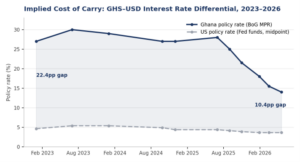
Exhibit 1: Implied cost of carry, the rate differential that drives the forward premium (derived from policy rates, not a quoted forward).
In plain terms, the price of certainty has fallen. That is exactly when disciplined treasurers move, not when the market is shouting, but while it is still speaking softly.
Why the window may not stay open
That window is already narrowing. At its July 2026 meeting, the Bank of Ghana's Monetary Policy Committee held the policy rate at 14% for a third consecutive time, citing renewed inflation risk from the escalating conflict in the Middle East⁵. Crude oil has moved above US$85 a barrel following the closure of the Strait of Hormuz, and the Committee flagged this alongside possible utility tariff increases as upside risks to the inflation outlook. None of this has fed through into the interest-rate gap yet, which is precisely the point.
A forward premium this narrow reflects a domestic and global environment that is, for now, still calm. That is exactly the condition treasury policy should be built around, not the one boards wait to see confirmed. If oil-driven cost pressure and renewed global uncertainty widen Ghana's rate differential again, the cost of locking in today's rate will rise with it. Certainty bought now is certainty bought at this month's price, not next quarter's.
This is the pattern boards should recognise, and it is the same one that caught the finance director's team at the start of this piece. Markets look calm, the rate holds, and treasury desks quietly deprioritise cover because nothing feels urgent. Then a shock arrives, a conflict, a tariff shift, a currency move, and desks with no policy in place are forced to buy dollars at the worst possible moment, once forward premiums have widened and spot has already gapped. What would have been a routine hedge becomes a scramble, and the scramble is what turns a manageable cost into a loss. Panic buying at the top of a spike is not a strategy; it is the absence of one, priced in real time.
A worked example
What that looks like in practice is simple. Take a Ghanaian importer with a US$500,000 payment due in 30 days. Spot is 11.63 to the dollar; the 30-day forward is 11.70⁴. The decision is not whether management can call the settlement rate. It is whether to carry that outflow into next month exposed or fix it today.
Locking in the forward fixes the obligation at GHS 5.85 million (US$500,000 × 11.70). That is a known number the CFO can budget, price and fund against. If the currency weakens to 11.90, the hedge has done its job and the cost holds. If it strengthens, the company gives up a better spot rate. That is the trade-off, not a flaw. Hedging is not about beating the market on the day; it is about removing the currency from the performance question, so margins and cash flow stay under management's control rather than the market's.
Four questions every Board should ask
For directors, the practical test is whether the business has answered four questions before the market forces them:
- How much of our earnings volatility is attributable solely to the cedi?
- Which exposures are strategic, and which are retained by default?
- Does our treasury policy reflect today's market, or yesterday's?
- If the cedi moved 10% tomorrow, would the outcome be planned or a surprise?
Volatility will return; only its timing is uncertain. Every company already has an FX strategy, some written down, others inherited through inaction. The market does not distinguish between the two. The firms that come through strongest are the ones that bought certainty while it was cheap and still hold the currency they secured, while others are booking an emergency meeting. Treasury's role is not to predict the future. It is to make the future less able to disrupt the business.
In volatile markets, certainty is not a luxury. It is the difference between reacting to the cycle and leading through it.
Global Markets Executive Insights is a thought-leadership series for corporate leaders, finance executives and Boards, offering strategic insight rather than product promotion.
Sources: ¹ UNCTAD, World Investment Report 2024. ² Ghana Statistical Service, 2023 Trade Report. ³ Bank of Ghana MPC releases (2024–26); US Federal Reserve. ⁴ Illustrative rates, for explanatory purposes only. ⁵ Bank of Ghana, MPC Press Release, 131st Meeting, July 2026.

Andrew Arde-Acquah, Manager, Global Markets Sale, Corporate and Investment Banking, Stanbic Bank Ghana
Comments